Payrail Agent Search
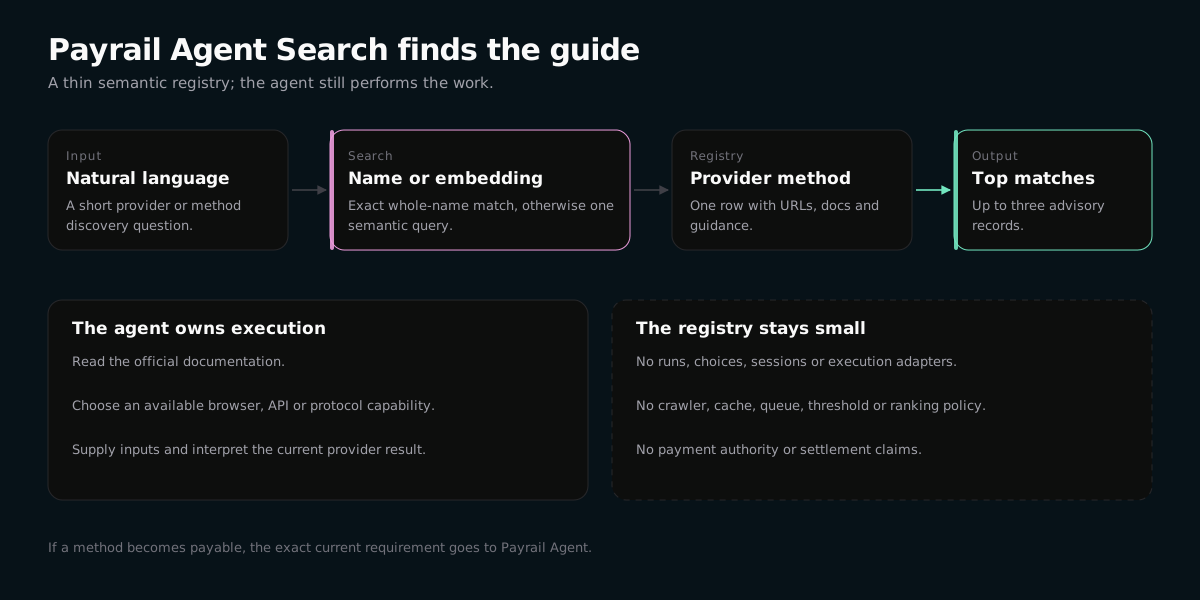
Payrail Agent Search answers natural-language discovery questions with provider and method names, useful URLs, official documentation, and concise operating guidance. The agent performs the work.
- One database row per provider and method.
- Semantic search over provider, method, and guidance.
- Returns up to three advisory matches with URLs and an official docs URL.
- Keeps execution, browsing, authorization, and payment outside the registry.
One Provider-Method Record
Each enabled record describes one provider and one method. Actions such as paid discovery and a later purchase stay in the guidance text instead of becoming separate database rows or workflow types.
type ProviderMethod = { provider: string; method: string; urls: string[]; docsUrl: string | null; guidance: string;};Natural-Language Search
The agent sends one short natural-language query. Exact provider or method names use a deterministic name path. Other queries use one text-embedding-3-small embedding and exact pgvector cosine ordering. The registry returns the nearest three enabled methods without thresholds, pagination, or scores.
const { matches } = await search_provider_methods({ query: 'find live hotel availability through a paid API',});Guidance, Not an Action Schema
Guidance follows a simple editorial template: Purpose, Instructions, and Notes. It can explain entry points, required inputs, expected results, side effects, paid discovery, and purchase behavior. The API treats it as bounded plain text rather than parsing Markdown into another protocol.
Agent-Owned Execution
A match is a guide, not a callable capability or approval. The agent reads the official docs, chooses an available capability, supplies ordinary inputs, executes the provider method, and interprets the result. If the method becomes payable, the agent brings the exact current payment requirement to Payrail Agent.
- Payrail Agent Search does not browse, call provider APIs, or keep execution state.
- Payrail Agent Search does not create choices, approvals, payment operations, or receipts.
- Payrail Agent remains responsible for exact payment identity, approval, settlement, and reconciliation.
Small Operational Surface
Operators edit the six public fields and enabled state in backoffice. Content changes generate a new embedding before the row is saved; URL-only edits reuse the current vector. A semantic embedding or database failure returns search_unavailable instead of silently changing the meaning of the result.
- No cache, queue, retry worker, crawler, or separate search service.
- No action rows, metadata JSON, ranking rules, or approximate-vector index.
- Disabled drafts may omit embeddings; enabled records may not.